Listening as we disagree

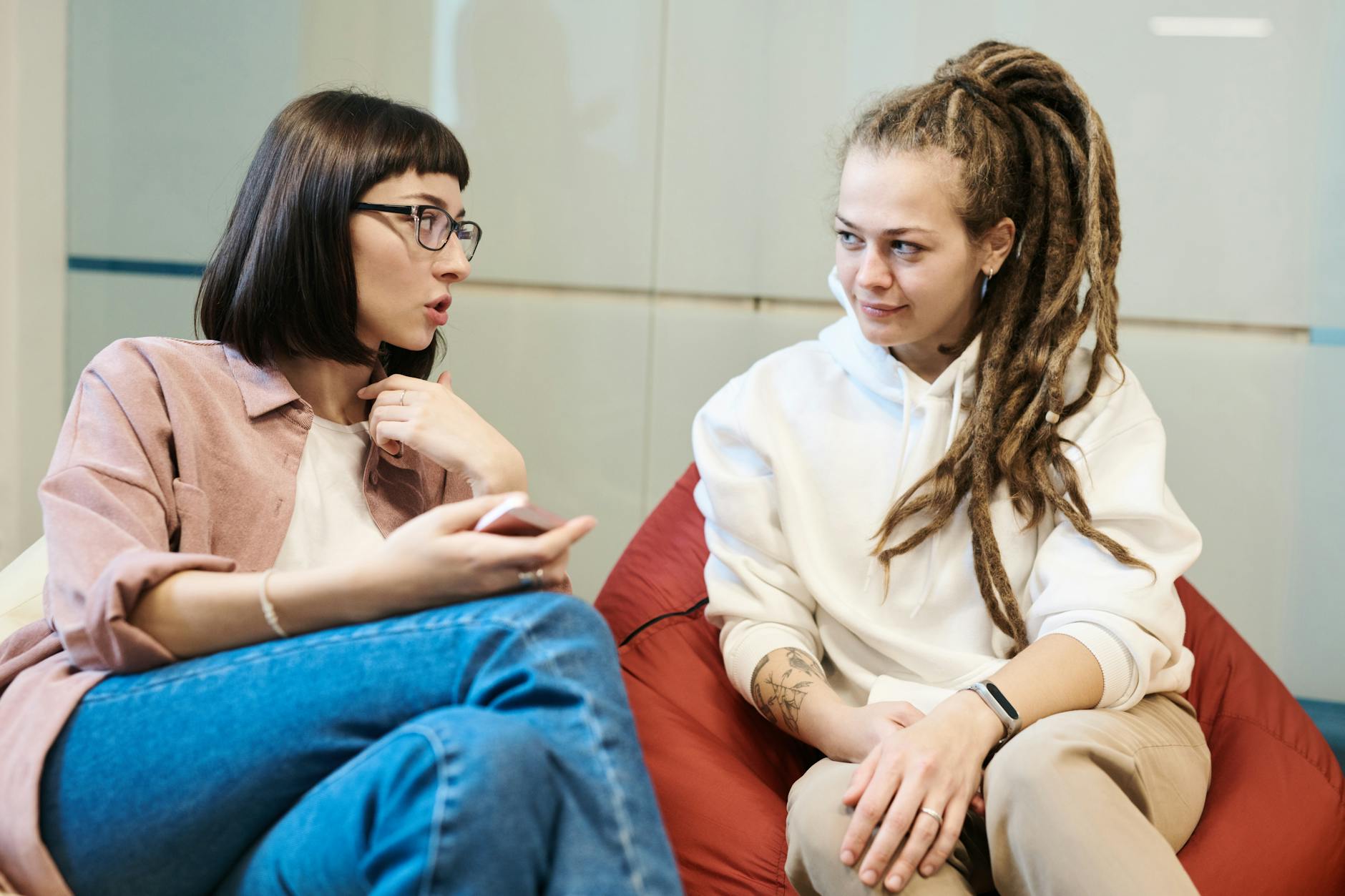
Photo by fauxels on Pexels.com

Words from Valarie Kaur… 

It turns out it is extremely difficult to draw close to someone you find absolutely abhorrent. How do we listen to someone when their beliefs are disgusting? Or enraging? Or terrifying?… An invisible wall forms between us and them, a chasm that seems impossible to cross. We don’t even know why we should try to cross it… In these moments, we can choose to remember that the goal of listening is not to feel empathy for our opponents, or validate their ideas, or even change their mind in the moment. Our goal is to understand them… 

When listening gets hard, I focus on taking the next breath. I pay attention to sensations in my body: heat, clenching, and constriction. I feel the ground beneath my feet. Am I safe? If so, I stay and slow my breath again, quiet my mind, and release the pressure that pushes me to defend my position. I try to wonder about this person’s story and the possible wound in them. I think of an earnest question and try to stay curious long enough to be changed by what I hear. Maybe, just maybe, my opponent will begin to wonder about me in return, ask me questions, and listen to my story. Maybe their views will start to break apart and new horizons will open in the process… Then again, maybe not. It doesn’t matter as long as the primary goal of listening is to deepen my own understanding. Listening does not grant the other side legitimacy. It grants them humanity—and preserves our own. 

A recent sermon, inspired by these words from Valarie Kaur…

During my years as a college chaplain, I always attended national Interfaith college chaplain conferences. Each February, a diverse group would meet, and Interfaith work was always a primary focus. We would explore how we could create and encourage an environment where people could be in community across faith differences. One year, Valarie Kaur was one of our primary speakers. Kaur is a renowned Sikh activist, filmmaker, and civil rights lawyer, and this particular conference was on the eve of her new book, See No Stranger, being published. The book was a call to Revolutionary Love. Kaur was a young adult in 2001, who felt called to action after the murder of Sikhs in the post 9/11 violence against anyone perceived to be Muslim. Kaur took this time to dig more deeply into her own faith, and look for a way to move forward amidst great division and hate.  

Instead of seeing a stranger in people who seemed so very different from herself, she wrote these words – You are a part of me I do not yet know. 

Those are not easy words in today’s world. Hate, violent rhetoric and actions, rampant misinformation, and the demonization of others, is all around us. It’s hard to believe we live in a world where meteorologists are getting death threats and FEMA employees, whose entire job is about helping people in dire need, are dealing with threats of violence.  

Now, I am not standing here today saying that I have the answers about how to heal such deep divisions, and create a world of unity and respect. Valarie Kaur is one of the people, especially from her religious perspective, who has some profound insights about how we can work towards a better world – but this is lifelong work. And there are no easy answers.  

What we can do is use our spiritual foundation to guide us in how we are present in such a world. 

And we can’t control how others respond – we are only responsible for how we act, and how we respond. 

Let’s hear again the one sentence Kaur wrote with her focus on Revolutionary Love – You are a part of me I do not yet know.  

That’s actually not an easy message for us to hear. If there is someone with whom we don’t agree – perhaps vehemently about vitally important issues of life and death – our natural response is to think “We are nothing alike!” It’s natural to demean the other, make fun of them, denigrate them – in essence, refuse to see their own humanity. 

Now I am not stating there is not evil in the world, and that we must do all we can to combat that. But that’s a different sermon series. 

Today, our focus is on how we listen as we disagree, especially in interpersonal relationships. 

And seeing the humanity in the other is the beginning of how we can do that. 

You are a part of me I do not yet know. 

Pioneering psychotherapist Carl Jung wrote about the concept of a “shadow side.” Everyone has a shadow – not just a literal one. It is the darker side of the consciousness that people normally don’t want to acknowledge or accept. It contains the more negative aspects of who we are, but it is part of who we are – and ignoring or denying them only gives the shadow more control over us. Ignoring a shadow side can also be highly problematic for a society – which is an issue the United States has had since its inception – ignoring the sins of enslavement, racism, the genocide of indigenous people. Ignoring or denying the shadow only gives it power. 

You are a part of me I do not yet know. 

We first recognize the humanity of the other, and we then truly listen and hear their story. There is a saying, “Hear the biography, not the ideology.” As we have been exploring deep listening this month, we know it’s important to listen to where other people are coming from – their context and situation in life – because it helps form who they are and how they connect with the world.  

How many times have we better understood someone once we know more of their story? 

Valarie Kaur offers these words….Deep listening is an act of surrender. We risk being changed by what we hear….Empathy is cognitive and emotional—to inhabit another person’s view of the world is to feel the world with them. But I also know that it’s okay if I don’t feel very much for them at all. I just need to feel safe enough to stay curious. The most critical part of listening is asking what is at stake for the other person. I try to understand what matters to them, not what I think matters. 

Listening as we disagree begins with acknowledging the humanity in the other, striving to understand more about their own biography, and lastly – finding points of commonalities.  

With all the years I have engaged in interfaith work, we never began by talking about our differences – different beliefs, rituals, actions. We always began by finding common ground. It might be interpersonal things – similarities with family or pop culture, or favorite books or music or food. And then we can look for larger commonalities about more important topics – beliefs, rituals, perspectives. 

Commonalities enable us to see the humanity in the other more easily. 

Commonalities enable us to connect with another. And when we do that – it changes us as well. Anyone who has truly done Interfaith work knows that they are changed – in small and sometimes big ways – listening as we disagree means that we are transformed as well. 

You are a part of me I do not yet know. 

It is my hope, and prayer, that in the coming months our society can move towards a time of healing. UU values honor the unique perspective of each person – we know we will ALWAYS disagree with others, and this is not a bad thing. It is how we deal with disagreement that does the damage.  

The process of healing the larger whole begins with two people at a time. We aren’t responsible for the outcome – we aren’t responsible for how others respond – but it is up to us how we engage with our own spirits and follow our own cherished beliefs. Deep listening as we disagree speaks to the best of our selves – our whole selves. We open ourselves to whatever change may come, as we open ourselves to deep listening. 

You are a part of me I do not yet know. 

Mystic Mag Interview!

Click here to find out more about my story and who I am as a spiritual specialist!

Local Hero

So excited to be recognized as a Local Hero in the Winston Salem Magazine for the work I do with spiritual wellness!

1


The Spirituality of Wonder Woman in the age of Trump

wonderwomantrump

drawing by demsey satya nagara

I was obviously not the only person anxiously awaiting the new Wonder Woman movie this past weekend. The long anticipated movie has been record breaking in numerous ways, but as I sat in the darkened theater with my teenage daughter, I could only think that the current state of political and societal affairs led to an even greater positive response to this female centered movie.

Diana is an Amazon, shielded from the world until a WWI soldier appears, and she decides to leave her home forever so she can protect the millions of innocents losing their lives. Her mother, Queen Hippolyta, gives these parting words, “Those men don’t deserve you.” Diana quickly finds herself in London, a city representative of a world where women are constrained by politics, society, and even fashion. She is thrown out of a room where the white men in power make decisions that impact the world, a woman who is only seen as distractingly pretty with a limited mental capacity for the big decisions of the world. The visual of Diana circling a room of men in power is far too similar 100 years later to the real images which have emerged from Trump’s White House of white men making decisions which directly impact countless people not represented in that space.

Diana’s strength and power are amazing and awe-inspiring. Yet, what truly makes this movie so good is her heart. We see it breaking when she witnesses women and children living in terrible conditions, being enslaved, and dying due to the war raging around them. Again, modern images burst through my internal vision as I placed the fictional faces side by side the real children from Syria and Mosul. The climactic scene of the movie is a battle with Ares, the God of War. As he tries to convince Diana that humans have chosen the atrocities, he echoes the words of her mother about what people deserve for the decisions. She responds, “It’s not about what you deserve, it’s about what you believe, and I believe in love.”

The age of Trump is about believing that those in power deserve that power. They deserve the money, the finer things of life, the best health care, the autonomy to believe that no circumstances of birth or assistance from countless people along the way led them to their place in life. It is the false ideology of the Christian prosperity gospel – that we get the rewards in life we truly deserve.

Diana, as Wonder Woman, is a hero we need today. She knows people do not always get what they deserve, and innocents suffer daily for the hubris and narcissism of the men (and I intentionally use this word) in power. The movie concludes with her in the current day, declaring that she stays and fights for love. She loves humanity and works towards a better day.

In a society where women are gravely underrepresented politically, where women and people of color and children suffer disproportionately, where the President sows seeds of fear and lies – we need a beacon of hope and love. Wonder Woman is fictional, but director Patty Jenkins is not. And sometimes our greatest truths can be inspired by mythical stories. Women and men, and people of all colors, can partner together to create a world where everyone has a seat at the table. We can rid ourselves of the language of who might deserve this or who might deserve that, and know that love means everyone deserves a better life. This is the spirituality we need in today’s world.

A Spirituality of March Madness

Image

As a native North Carolinian, March doesn’t just indicate the beginning of Springtime and new life. Individuals in my state spurn the emerging outdoors to spend hours and hours on a coach in front of a tv. One will ignore everything else to flip between games, mark up her printed bracket when a favored team loses on the first day, and then toss out texts or quick voicemails to friends who made different picks. There isn’t much greater joy for a North Carolinian than having more Men’s Basketball tourney picks right than everyone else. (I will confess – I still have my 2001 bracket, when my beloved Blue Devils won the championship and I only missed 8 calls out of the 64 games.)

March Madness normally coincides with Lent, the Christian season for giving up things we don’t need in our lives and instead focusing on walking the spiritual journey with Jesus. With all the countless people I know who observe the season of Lent, I am very hard pressed to think of people who have abstained from tv. March Madness seems to draw one away from the sacred path. We are more likely to use foul or abusive language, perhaps at the referees or struggling players or coaches. We tend to eat junk food and consume a fair amount of beer. We might be petty if our team wins and our friend’s rival team loses. This whole thing is all about competition, right?

Yet, I do believe March Madness can offer some opportunities for us to grow along the spiritual path. Basketball is a sport accessible to practically anyone in our country. One just needs a ball and a hoop. Public playgrounds and recreation centers have these in abundance. No special shoes, fancy equipment, specialized training. As Jesus invited everyone – regardless of status, background, culture, or gender – to join his movement, so anyone can pick up a ball and start playing.

One of the things I love about this sport is the team aspect. There is normally a more gifted player, who might score most the points, or have most the steals or rebounds. Yet, all 5 members of the team are essential to the success of the 40 minute journey of a game. As 1 Corinthians tells us, the eye is just as important as the ear as is the head as is the foot or heart. They must all work together as one body.

Basketball takes a great deal of hard work and effort. There is no coasting on past achievements. One of the great stories during this season has been the reemergence of Rasheed Sulaimon, a young Duke player. One of the stars of the team last year, he endured some personal struggles and found himself on the bench for a while as his commitment to the game waned. Yet, he persevered, never gave up, and eventually was able to work through the difficulties in his life and once again become one of the most reliable Duke players. The spiritual journey is not an easy one, and some days or weeks or months are much harder than others. Yet, perseverance, struggling through the droughts, is always worth the effort.

Life is obviously more complex and intricate than sports, even a great game like basketball. Yet, I pray during this season of Lent, that I will remember the important things. I’m not saying I won’t gloat on Facebook about a particularly good pick, especially if my friends don’t agree – because I know I will 🙂 I am simply sending up a prayer that I will remember the gifts of something like basketball, and help incorporate those inspirations in my own spiritual journey.

More in the Season of Lent

Image

            Yesterday I heard a colleague spouting these words as she left a meeting, “No alcohol! No sweets!” Being on the tail-end of the conversation, I responded, “That sounds awful!” My immediate thought was her doctor had insisted on the restrictions. She quickly replied, “Oh, it’s Lent, you know.” I felt a tad bit chagrined. Being the only clergyperson around, I should have immediately known the reference.

             Lent is one of those odd times of the Christian year. Many people will “give up” or “sacrifice” something during those 40 days (minus Sundays) prior to Easter. These items often focus on food or luxuries. Alcohol, sweets, red meat, television, fast food – all these things are commonly associated with the season. Yet, why do we give up something? Is it a habit, just a thing to do? Is it a spiritual discipline? How do we hope to grow in our faith by sacrificing something we probably don’t really need anyway?

             When my kids were little, and I began to introduce the concept to them, I focused a great deal on what it means to have too much. In our society, we are almost obsessed with wanting more – more money, more free time, more possessions, more youth, more beauty, more success. And yet, so many of us have so much more than we truly need. (Now today’s thoughts are not directed towards the millions who are struggling to get by, who are dealing with food endangerment, and are on the edge of homelessness. It’s for the rest of us – the majority in this country.) I told my children that when we are so focused on wanting more, we have a really hard time focusing on Jesus and who he wants us to be. I explained that he lived his life in poverty, and wants us to help those who are struggling. When our lives are filled with excess, it’s really hard to do that. The whole camel through the eye of a needle thing.

             We give up things during Lent so that we have the heart, time, and space to focus on empowering those who don’t have more. We give up things during Lent so that we can identify, in some small manner, what it is like to do without. We give up things during Lent so we can walk in the path of Jesus.

             What am I giving up during Lent? Fast food. I have a real thing for fizzy Diet Cokes, and realized during the dark winter days how dependent I had become upon them. And I know many people in the world don’t have the extra few dollars to buy a soft drink from a fast food chain. Will I succeed in this endeavor? I surely hope so. I never maintained my promise during the years I gave up chocolate. (If the Girl Scouts wouldn’t deliver cookies during Lent, I would have had a better chance at success.) Regardless of success or not (after all, wanting “more success” will not enhance my spiritual journey), I pray that these days will create more space in my heart, soul, and mind so that I might see the needs around me, and might be filled with the Christ spirit to find ways to help meet those needs.

             I wish you all a fruitful Lent.